



- 01
Ramayana Goes Global: 3D Teaser to Debut with Avatar: Fire and Ash
Before we move on, let’s clarify one thing upfront: attaching the Ramayana 3D teaser to Avatar: Fire and Ash is not marketing, but rather messaging. Let’s not dress this up as “smart marketing.” Because that would be underselling it.Attaching the Ramayana 3D teaser to Avatar: Fire and Ash isn’t about reach. It’s about relevance.
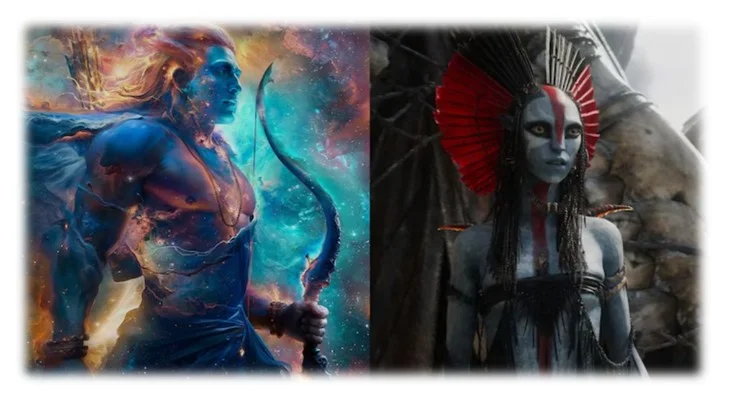
So when Indian cinema chooses that moment to introduce its most revered epic, it’s making a quiet but thunderous point: “Our stories aren’t regional.” “They’re universal.” Because Indian cinema didn’t ask to be compared, it placed itself where comparison was inevitable and let the visuals do the talking. Ramayana 3D doesn’t ask viewers to compare it to Avatar. It lets the comparison happen naturally. And that’s the boldest move of all. Because only stories secure in their legacy can afford that kind of restraint.
This isn’t Hollywood versus India. This is imagination versus inheritance. Technology versus timelessness. And suddenly, the question isn’t “Can Ramayana match Avatar’s scale?” It’s “How big does the screen need to be for a story this old?” Moreover, from this moment on, Indian epics won’t be introduced cautiously. They’ll be launched decisively. Because when you believe in your story this deeply, you don’t test the waters. You dive straight into the deep end.
Why Avatar? Why now?
Here’s the part that clicks once you think about it. Avatar audiences aren’t casual moviegoers. They don’t just watch films. They enter worlds. Avatar doesn’t pull in passive audiences.It attracts believers .People who want: a world to get lost in,
characters to argue about ,and values that linger long after the credits roll. There is a reason Avatar has never been treated like just another blockbuster. Its audience does not simply watch the film; they commit to its world, its rules, and its emotional logic.
Ramayana has always operated in that space. It is a universe built on values, choices, and consequences that extend beyond one generation. By aligning Ramayana 3D with Avatar: Fire and Ash, Indian cinema is not following a trend but responding to an audience that is already primed for epic storytelling with depth.
There was a time when mythology was treated as niche or culturally specific. That moment has passed. Today’s global audiences actively seek stories that feel rooted, symbolic, and morally layered, even when they are wrapped in visual spectacle.
One myth is newly created. The other has endured. Both demand a screen big enough to hold their meaning.
Why the 3D factor changes everything?
Let’s be honest, Indian mythology adaptations have rarely failed because of weak stories. They have struggled because the execution often could not match the scale and seriousness of the material. The intention was always sincere, but the visual language often felt symbolic rather than immersive.
This teaser feels like a conscious course correction. The use of 3D is not about spectacle for its own sake, but about depth, texture, and presence. It suggests a Ramayana that unfolds visually, without constant exposition or exaggerated cues telling you how to feel. Mythology asks for belief, but belief does not come from dialogue alone. It comes from environments that feel real, spaces that feel inhabitable, and worlds that feel consistent.
After years of immersive global epics, modern audiences expect mythology to surround them, not simply present itself. If belief is the foundation of myth, then immersion is the structure that holds it together. This teaser feels different because it understands something crucial. Modern audiences do not want to be told to believe anymore; they want to feel belief forming as they watch. The 3D here is not shouting for attention. It is quietly doing the heavy lifting by adding depth, scale, and texture to every frame.
After being immersed in global epics for years, audiences will not settle for half-built worlds. If Ramayana is meant to inspire belief, then it needs to feel real enough to live in, even if only for a few hours.
What does this mean for Indian mythological cinema?
If this teaser delivers on what it promises, it could change how mythology is perceived across the industry. Instead of being treated as a risky or limited genre, mythological cinema could finally be seen as a space for scale, innovation, and long-term storytelling.
With success comes confidence, and with confidence comes investment. Filmmakers will be encouraged to think cinematically rather than cautiously, allowing visuals and emotion to carry the story instead of constant moral explanation. If this film succeeds, that fear begins to dissolve. Mythology will be treated as cinematic material first, not as a risk category. Filmmakers will feel freer to trust visuals, trust silence, and trust the audience’s intelligence. As confidence grows, budgets will align with vision, not caution. Storytelling will naturally evolve from instructive monologues to cinematic moments that allow meaning to emerge organically.
If this film works, future filmmakers will feel encouraged to dream bigger, build deeper worlds, and tell these stories visually rather than defensively. Mythology will no longer feel like a genre that needs justification. It will feel like a foundation.
The emotional undercurrent no one is talking about
Beyond the strategy, the scale, and the spectacle, there is something quietly emotional happening here. For many Indians, Ramayana has never been just a story consumed on screen. It has lived in bedtime conversations, in grandparents’ voices, and in moments where morality was taught without ever feeling like a lesson.
People did not first meet these characters in theatres or on streaming platforms. They met them through stories told at night, through voices they trusted, and through lessons that stayed long after the story ended. Hence, watching it now enter a global cinematic space does not feel like a debut. It feels like recognition catching up with memory. It feels like something private being understood publicly for the first time. Seeing it placed on the world’s biggest cinematic platform does not feel like a flex. It feels like belonging. It feels like the story is stepping into a space it always occupied emotionally but never visually.
The emotion here is not celebration. It is recognition. Not “Look what we made,” but “Look what has always lived with us.”Seeing it acknowledged on a global cinematic stage does not feel like a victory. It feels like being understood. Like something intimate has finally been met with the respect it quietly carried all along.
Read also
Is this a test and a turning point?
The teaser has not even officially dropped yet, and it has already done something rare. It has sparked conversation, shifted perception, and forced people to rethink what Indian mythology can look like on a global screen.
If the film delivers on its scale and sincerity, this will not just be a successful teaser debut. It will be remembered as the moment Indian mythology stepped forward without hesitation, without apology, and without shrinking itself for global comfort. By choosing where and how this story is introduced, Indian cinema is sending a clear message to audiences and industries alike. It is ready to treat its mythology not as nostalgia, but as a cinematic property with global weight.
If this works, it will not just mark a successful global debut. It will mark the moment Indian mythology stopped looking inward and trusted the world to look back.

I craft sharp reels, video reviews,technology updates, latest developments and trend analyses,known for deep research, clear insights, and compelling sforytelling across the latest in film and pop culture.