



- 01
How 20000 Workers Built the Taj Mahal?
This is my opinion. The Taj Mahal is known almost everywhere around the world. We have all seen it in books, movies, and social media posts. Most of us have it on our bucket list.
But very few take a moment to think about how it was constructed.
Have you ever thought about those who physically carried up the stones?
Behind the untouched white marble sits a vast domestic unravelling. One being almost twenty thousand employees. The one of enduring, mastery, and coming together.
Why the Taj Mahal Was Built
The Mughal emperor Shah Jahan was the person who erected the Taj Mahal. It was a gift for his wife Mumtaz Mahal. She passed away in 1631 during childbirth.
Shah Jahan was madly in love with her. He was never the same after her death.
Therefore he wanted to create something that would immortalize her forever.
The Taj Mahal was more than just a tomb. It was a symbol of love and separation. It was designed to be everlasting.
Who Were the 20,000 Workers
The workers belonged to many different places. It was not just the people of Agra who were employed. To a great extent, they had workers not only from different parts of India but also from other countries.
They employed stone cutters from Rajasthan. Besides, experts in calligraphy were from Persia. The architects came from Turkey. The laborers were from the villages around the city.
Some workers were masterful artists while others quite robust. Both as a group and individually, their contribution was equally necessary.
Once I tell you this, you will be amazed that even the tiniest pattern had to be made by very skilled people.
How Long Did the Construction Take
The Taj Mahal was built over a period of nearly twenty-two years. The construction began in 1632 and was completed around 1653.
This was certainly not a hastily made decision. They scrutinized every move before the implementation.
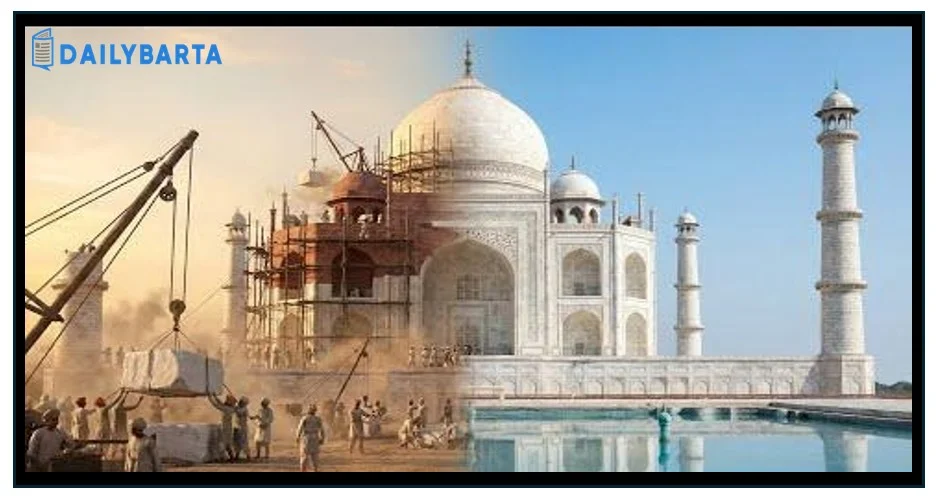
The workers were divided into different groups depending on their shift timings. Some of them were working on stone carving, others were engaged in material transportation while some were solely devoted to polishing.
Therefore the monument slowly and steadily took shape over many years.
How Heavy Materials Were Moved
One of the major difficulties was transporting marble. The white marble that was used for the Taj Mahal was sourced from Makrana in Rajasthan. That location is over two hundred kilometers away from Agra.
At that moment there were no trucks or cranes. Stones were transported with the help of bullock carts and elephants.
Massive mud and brick ramps were constructed around the site to the different levels. These ramps were used by the workers to drag stones up higher levels.
Can you imagine hauling such heavy stones without any machinery?
It demanded great physical strength and flawless teamwork.
Daily Life of the Workers
The workers’ life was tough as they labored long hours under the blazing sun. Their labor was not only very slow but also extremely taxing.
However, according to records, they were paid quite generously for that era at least. In addition, they were provided with food and shelter close to the construction site.
There were small residential areas that sprang up around the Taj site. The families stayed there for years.
This is how I see it. The Taj Mahal is not the work of strangers. It is the work of a community.
The Art Behind the Beauty
The enchantment of the Taj Mahal dwells in the minutest details of the monument. The flowers on the walls, for instance, are not an artwork. They are inlays of precious stones set into marble.
Such decorative technique is termed as pietra dura. Notable artworks in jade, turquoise, and lapis lazuli were produced. Each piece of stone was meticulously cut and placed manually. A tiny error might have annulled several days of work.
Therefore craftsmen were very careful, taking their time and concentrating fully.
Calligraphy and Optical Genius
The Quranic inscriptions adorning the Taj Mahal were executed with black marble. These letters vary in size. The characters at the top are a bit larger than those at the bottom. This was done to make the inscriptions appear to be of equal size when viewed from the ground.
Believe it or not, but this goes to show how clever the architects were. They grasped the functioning of human eyes.
Myths About the Workers
There are many versions of the story that say Shah Jahan mistreated the workers after the Taj was finished. Some say he ordered their hands to be cut off!
Such claims lack solid evidence.
Historians mostly think that the workers were treated with respect and given rewards. Skilled workers were the treasure of any period, including the Mughal.
One should rely on real facts rather than exaggerated stories.
Why the Taj Mahal Still Matters Today
The Taj Mahal is not only a tourist destination. It symbolizes what mankind can accomplish when united. 20,000 people worked with great patience and discipline. They believed in their abilities and helped one another.Everybody knows that great things take time. That is probably the main message of the Taj Mahal.
Would you agree that we still possess such patience?
Conclusion
The Taj Mahal is a symbol of great human work. It is not a result of the use of machines. It is not a result of shortcuts. It is the human spirit and the faith in the work that makes it stand today. Each stone is a piece of the story. Every turn is the work put in.
This is the reason why the Taj Mahal continues to move people’s hearts even after so many years.

Hi i am simarpreet From Delhi. I am writting on video reviews and trend analyses,known for deep research, clear insoghts, and compelling sforytelling across the latest in film and trending news.